Not so long ago, investing was something most people did through a middleman. You might have owned shares through a retirement fund, spoken to a financial adviser or called a broker when you wanted to buy something, but the financial markets themselves felt like a world inhabited by professionals. They had the terminals, the research, the analysts and the information, while everyone else received a much more limited view of what was happening. Technology has now dismantled much of that divide.
Today, almost anyone with a smartphone can open an investment account, examine a company’s financial results, watch markets moving in real time, read announcements seconds after they are released, and buy shares without ever speaking to another person. Research that once required expensive financial services is readily available online, while sophisticated charts and analytical tools can be accessed for little or no cost. Even international markets that once seemed remote can now be reached from the same device people use to order dinner.
It is difficult to see that as anything other than progress. Millions of people have gained direct access to something that was once considerably more difficult and expensive to participate in, and they have gained much greater control over decisions involving their own money.
But something else changed at the same time, and it may ultimately matter just as much.
The problem used to be getting enough information to make a decision. Now the problem is deciding which information deserves to influence one.
WHEN INFORMATION STOPPED BEING SCARCE
Imagine trying to research a company several decades ago. You might have read its annual report, followed financial newspapers, spoken to a broker or waited for an analyst’s research to become available. Information certainly existed, but obtaining enough of it required time, effort and often money, which meant professional investors enjoyed advantages that were difficult for ordinary investors to overcome.
The internet steadily eroded that advantage. Company announcements became instantly available, financial databases moved online, brokerage costs collapsed and investment platforms began putting increasingly sophisticated tools into the hands of ordinary people. The smartphone completed the transformation by making all of it available almost anywhere and at almost any time.
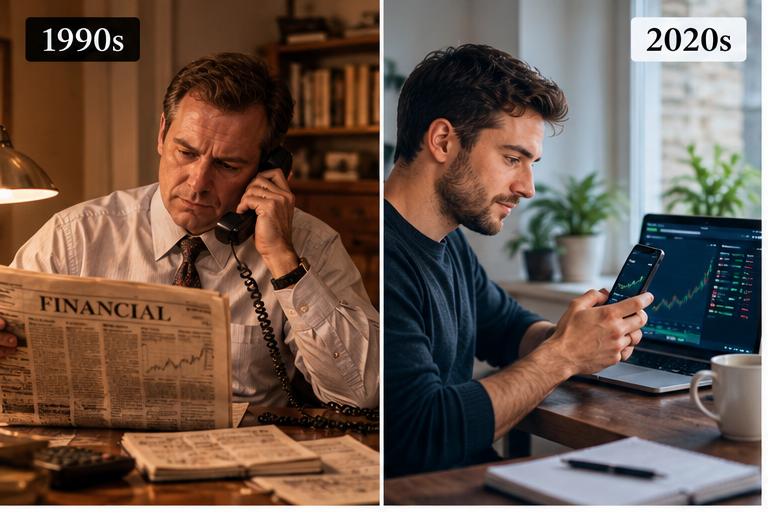
Yet solving the scarcity problem created an entirely different one.
Search for information about almost any widely followed company today and you won’t struggle to find an opinion. You’ll find analysts explaining why it is undervalued, commentators explaining why it is overpriced, YouTubers predicting where the share price will go next, Reddit users dissecting announcements, people on X reacting to rumors, and influencers compressing complicated investment arguments into short videos.
Some of those people will have spent weeks studying the company. Others may have spent ten minutes. Some will disclose that they own the investment they are enthusiastically recommending, while others may not. Many will genuinely believe what they are saying, and some will be completely wrong, despite sounding extraordinarily convincing.
This creates a problem previous generations of investors experienced on nothing like the same scale. The modern investor doesn’t merely need to find information; they need to filter it, and the sheer quantity available can make that harder rather than easier.
More information feels as though it should produce better decisions, but that only works when we can distinguish useful information from noise. Otherwise, abundance simply gives us more opportunities to find an argument supporting whatever we already wanted to believe.
The old advantage was having access to information. The new advantage may be knowing which information to ignore.
WHAT HAPPENED WHEN THE MARKET MOVED INTO OUR POCKETS
The transformation wasn’t only about information. The act of investing itself became almost frictionless.
There was once a natural delay between thinking about buying or selling an investment and actually doing it. You might have needed to telephone a broker, discuss the trade and pay a commission significant enough to make you think twice about constantly moving in and out of positions. That process could be slow and expensive, and there is no reason to romanticize it, but the inconvenience had an unintended consequence: It created a pause between emotion and action. A smartphone can remove almost all of that pause.
You can wake up to a frightening headline, look at your portfolio, watch a share price falling and sell before breakfast. Later the same day you might see another company surging, read excited comments from people who appear to be making enormous profits, and buy because waiting feels increasingly like missing out. Neither decision requires much effort, and that convenience can create the impression that the decision itself has somehow become easier.
It hasn’t. Technology has simply shortened the distance between what we feel and what we can do with our money.
That distinction matters because fear, excitement, greed and regret have always existed in financial markets. Investment apps didn’t create those emotions, but they gave them an extraordinarily efficient execution system. The same technology that allows a thoughtful investor to act quickly when an opportunity appears also allows an anxious investor to react quickly when they probably shouldn’t.
This is one of the strange contradictions of modern investing. Removing friction has unquestionably made markets more accessible, but friction was never only an obstacle. Sometimes it gave people time to reconsider.
Removing the barriers to investing gave us greater control over our money. It also gave our impulses greater control over it.
WALL STREET LOST ITS MONOPOLY ON OPINION
There was another unwritten rule that technology helped dismantle: If you wanted a serious opinion about investing, you went to a professional.
That assumption deserved challenging. Professional investors regularly get things wrong, analysts disagree about the same companies, fund managers can underperform the markets they are paid to beat, and entire financial institutions can become trapped in assumptions shared by everyone around them. A job title and an expensive office have never guaranteed independent thinking.
The internet opened the conversation to everyone else, and there is real value in that. Independent investors can publish detailed research, challenge professional analysts and examine companies from perspectives that larger institutions may overlook. Communities can share information at extraordinary speed, while people who once had no public platform can demonstrate that expertise does not always come with a recognized title.
But removing one hierarchy did not automatically create a world in which good ideas defeated bad ones. Instead, it created millions of competing voices.
The person explaining a company online may be an experienced investor who has studied the business for years, or someone who bought the shares yesterday and desperately wants other people to push the price higher. Both can produce professional-looking charts. Both can speak confidently. Both can attract thousands of followers.
For an investor trying to think independently, that creates a different challenge. Rejecting the opinion of a Wall Street analyst only to automatically accept the opinion of a popular YouTuber is not independent thinking. Neither is buying something because thousands of people in an online community insist that the professionals have got it wrong.
The authority may have changed. The habit of outsourcing judgment has not.
WHAT GAMESTOP REALLY REVEALED
The GameStop phenomenon brought this new financial world into public view more dramatically than almost anything before it. Individual investors gathering online demonstrated that information and influence no longer travelled in only one direction, from large financial institutions down to everybody else. The episode showed that large numbers of individual investors gathering online could attract enormous attention, generate substantial trading activity and become a market force that professional investors could no longer ignore. That was a genuine shift in power, and it is one reason the GameStop story deserves its own place within NoRuleBook.
But there was another side to it that is just as interesting. Someone buying GameStop, because they had independently studied the company and reached their own conclusion, was doing something very different from someone buying because thousands of strangers online appeared to be getting rich and they were frightened of being left behind. Both people might have clicked exactly the same Buy button. Yet their thinking could have been completely different.
That distinction gets lost when financial independence is confused with simply having direct access to the market. A person can make their own trades while still allowing a crowd to make their decisions for them, and the fact that the crowd is challenging Wall Street doesn’t make it any less of a crowd.
There is a certain irony in escaping one form of conformity only to join another. For NoRuleBook, that may be the most interesting part of the entire transformation. The democratization of investing didn’t remove the need to decide who deserves to be believed. It transferred much more responsibility for making that judgment to the individual.
WHEN ACCESS STOPS BEING THE ADVANTAGE
For decades, greater access to financial information gave professional investors an obvious advantage because relatively few people possessed it. Today, much of that information is available to almost everyone, often within seconds of becoming public. Company announcements, financial statements, market data, analyst commentary and sophisticated charting tools are no longer particularly difficult for an ordinary investor to find. This changes what having an advantage actually means.
If millions of people can see the same announcement at roughly the same time, simply seeing it is unlikely to separate one investor from another. If everyone has access to charts, possessing a charting platform is not an advantage either. Even having enormous amounts of information available can become surprisingly unhelpful when thousands of competing opinions make it harder to distinguish what matters from what merely attracts attention.
What remains much harder to acquire is judgment, because judgment requires more than collecting information. It means recognising the limits of what you understand, separating what you know from what you hope will happen, and being prepared to reconsider an investment when the evidence changes rather than searching for another opinion that supports the one you already hold.
Perhaps most difficult of all, it means accepting that access to an opportunity does not create an obligation to take it.
That distinction matters more now because modern investors are exposed to opportunities almost continuously. There will always be another company attracting attention, another technology being described as transformative, another market rising rapidly enough to make those watching from the sidelines wonder whether they are being left behind. When those opportunities are visible every day and acting on them requires little more than opening an app, doing nothing can begin to feel like a decision that needs defending. It doesn’t.
Sometimes the most rational conclusion after researching an investment is that you don’t understand it well enough. Sometimes the potential reward does not justify the uncertainty. Sometimes an opportunity may be perfectly legitimate but simply unsuitable for you. And sometimes the best decision is to admit that you cannot confidently reach a decision at all.
None of this requires rejecting professional advice, distrusting financial institutions or assuming that independent investors somehow possess better answers. It simply means that access has transferred more of the final judgment back to us, and that judgment cannot be outsourced without giving away much of the independence that greater access was supposed to provide in the first place.
When information becomes unlimited, knowing what to ignore becomes a form of intelligence.
That may be the less celebrated consequence of the investing revolution. We spent decades making financial markets easier to enter and information easier to obtain, only to discover that neither automatically makes good decisions easier to make.
The old problem was getting through the door. That door is open now.
The challenge is deciding what deserves your attention once you’re inside.
Take The Next Step
This shift in investing reflects something happening far beyond financial markets. Technology has given us access to more information, more opinions and more choices than previous generations could have imagined, but greater choice does not automatically produce better decisions. In many cases, it simply places more responsibility on us to decide what deserves to influence the way we live.
That is one of the central ideas behind NoRuleBook. Independent thinking is not about automatically rejecting experts, institutions or conventional wisdom. It is about becoming aware of the influences shaping your decisions, examining them rather than simply inheriting them, and retaining ownership of the final choice.
If you want to become more aware of the unwritten rules influencing your own decisions, click the NoRuleBook image below to get your copy.
The NoRuleBook Collection
-
NoRuleBook
$9.95Original price was: $9.95.$7.95Current price is: $7.95. -
No Rules Start-Up
$19.95Original price was: $19.95.$9.95Current price is: $9.95. -
NoRuleBook Bundle
$22.90Original price was: $22.90.$14.95Current price is: $14.95.