


NoRules Japan : How Japan’s Unwritten Rules Are Finally Being Challenged
For decades, Japan has been admired for its order, discipline, and social cohesion. It is a country built on precision, respect, and an almost sacred adherence to unwritten rules. But beneath the surface, something is changing.
After spending nearly a decade living and working in Tokyo, I witnessed a quiet but persistent shift — a growing rebellion against Japan’s unwritten rules. Not loud. Not chaotic. But deeply consequential.
This is NoRules Japan emerging.
Japan’s Unwritten Rules Start Early
You can see the contrast early in life.
A Japanese infant on a train is naturally curious — interacting freely with the unfamiliar gaijin sitting nearby. That curiosity, however, is slowly trained out, and by the time formal education takes hold, inquisitiveness is replaced with conformity. Questions are discouraged. Uniformity is rewarded.
By adulthood, this conditioning shows itself clearly in the workplace.
But more and more office workers are quietly observing and noting how foreigners operate :
- Leaving work “early”
- Questioning instructions
- Prioritizing life outside the company
These behaviors clash with Japan’s deeply embedded company-first ideology — yet they linger in the background, planting doubt.
Are the Japanese Really Risk-Averse?
A long-running Japanese television show, Hajimete no Otsukai (now known internationally as Old Enough on Netflix), provides a fascinating contradiction.
The show follows preschool children running errands alone — something that shocked many Western viewers, who labelled it unsafe or irresponsible. Yet in Japan, it is entirely normal for young children to walk, cycle, or take trains independently.
So which is it?
Is Japan risk-averse — or selectively conservative?
The answer lies in where risk is tolerated. Everyday life allows independence. Social systems do not.
The Ideal Career : Stability at Any Cost
Ask Japanese parents what job they want their child to have, and the answers are remarkably consistent :
- National civil service
- Local government
- Toyota Motor Corporation
These roles promise stability and security — the highest social currency in Japan.
What they do not promise :
- High wages
- Work / Life balance
- Autonomy
Many of these roles demand 80+ hour work weeks while paying only marginally above the national average. Yet they are revered because they conform to Japan’s unwritten social contract : Sacrifice the self for the system.
Lifetime Employment and the Cost of Loyalty
Japan has one of the least mobile workforces in the developed world.
Only around 8% of Japanese workers have been in their job for less than a year, compared to 23% in the United States. This reluctance to change employers is not accidental — it is cultural.
Loyalty to company and country is prioritized over personal growth, salary negotiation and even family time. The result? Decades of wage stagnation and an economy that struggles to adapt quickly.
At the extreme end of this culture lies Karoshi — death by overwork — a word that exists because the phenomenon exists.
The Rebellion Begins : Youth, Risk, and Start-Ups
Here’s the shift : Young Japanese workers are opting out.
Government officials now openly express concern about Japan’s lack of start-ups, noting that the last major surge in new listed companies occurred shortly after World War II. Since then, entire technological revolutions — the internet, smartphones, electric vehicles — were largely missed by conservative domestic corporations unwilling to take risks. But the younger generation sees this clearly.
Workplace transience has reportedly increased five-fold since 2013. Young workers are :
- Changing jobs more freely
- Joining start-ups
- Forgoing “jobs for life”
- Valuing purpose over permanence
Security is no longer the ultimate goal. Optionality is. Read about Satori-no-Sedai and other Youth Movements here.
A Shift Toward Foreign Companies
Another clear signal of change : Career Aspirations.
Where government agencies, airlines, and car manufacturers once dominated preference lists, foreign companies now feature heavily. Apple, Alphabet (Google), and Microsoft are increasingly seen as desirable employers. This was unthinkable just a decade ago.
While these firms are not inherently risky, choosing them represents a profound mental shift — away from company-first loyalty and toward personal fulfilment.
Institutional Cracks Are Appearing
Even the government has begun responding.
“Leave work early” initiatives and pressure to reduce excessive hours suggest an acknowledgement that the old model is breaking down. These changes may seem small, but in Japan’s rigid social structure, they are significant.
NoRules Japan in Action
Japan’s unwritten rules are facing their greatest challenge since World War II. This is not chaos. It is recalibration.
The younger generation is not rejecting discipline or respect — they are rejecting meaningless sacrifice. They are questioning whether stability without fulfilment is a worthy goal.
This is NoRuleBook in action :
- Outliers questioning norms
- Individuals choosing agency
- Quiet rebellion reshaping a society
There is a whole chapter on global youth movements in the NoRuleBook eBook. Get your copy here
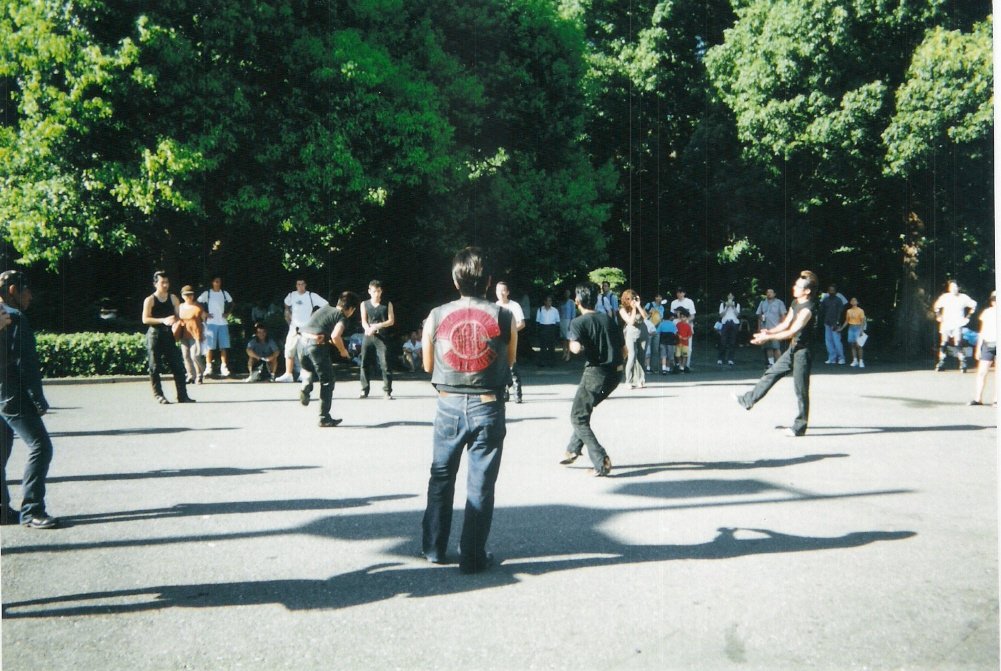
Western influence is changing conservative Japan. (Rockabilly Rebels in central Tokyo)

 Submitted 1.0
 Manual 5.0