

Dire Straits and Sultans Of Swing Was Never Meant To Be A Hit – It Was Just StoryTelling
Dire Straits began quietly. No explosion. No manifesto. No big scene behind them.
In 1977, London was loud. Punk was tearing down anything polished or patient. Bands were meant to be angry, fast, and disposable. Subtlety wasn’t welcome. Musicianship was almost suspicious.
Mark Knopfler didn’t fit that moment at all. He was in his late twenties. Older than most people trying to “make it” in music. A former journalist and English teacher. Soft-spoken. Observant. He didn’t dress like a rock star, didn’t behave like one, and didn’t play guitar the way anyone expected. He used his fingers instead of a pick, producing a clean, controlled sound that cut through without shouting.
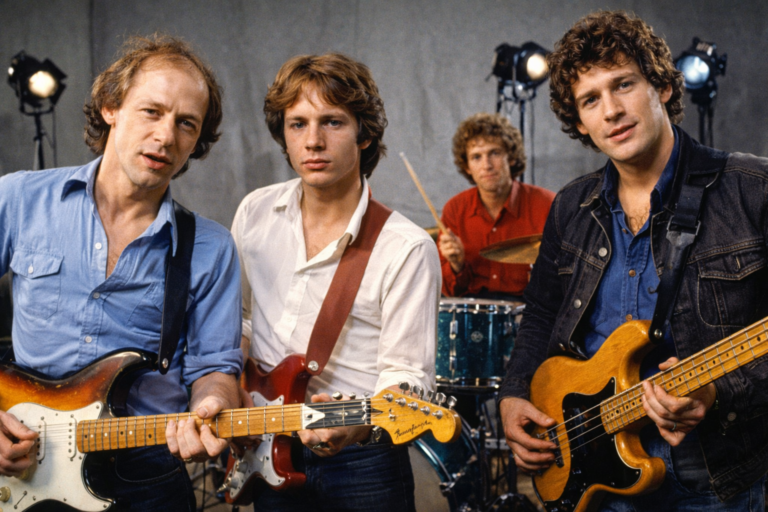
Dire Straits formed almost by accident. Mark and his younger brother David Knopfler were living in a small flat in Deptford, sharing cramped space and cheaper ambitions. They were joined by John Illsley on bass and Pick Withers on drums. There was no grand vision beyond writing good songs and playing them honestly.
Even the band’s name reflected that. Dire Straits wasn’t clever branding. It was a joke about how broke they were.
They rehearsed in borrowed rooms. They played small pubs. They refined songs slowly. No one in the band was chasing trends. In fact, they were doing the opposite—ignoring them.
That attitude would produce one of the most unlikely debut hits in music history.
The Song That Almost Didn’t Matter
“Sultans of Swing” didn’t start as a hit. It started as an observation.
One night, Mark Knopfler walked into a near-empty pub in South London. A small jazz band was playing on a rainy night to almost no audience. At the end of the set, the singer introduced the group as “the Sultans of Swing.” It was a grand name for a humble situation.
That contrast stuck.
The song Knopfler wrote based on that nondescript experience, wasn’t mocking. It wasn’t ironic, or even affectionate. It captured something real : Musicians playing not for fame, not for money, but because they loved the act itself.
The lyrics don’t shout. They don’t explain themselves. They just notice.
“You get a shiver in the dark
It’s raining in the park but meantime …”
It feels like a camera slowly panning across a scene. No judgment or drama. Just attention.
Musically, the song was just as restrained. No distortion. No aggressive hooks. The guitar lines were precise, conversational, and almost polite. In an era where bands were trying to sound dangerous and loud, Dire Straits sounded calm and confident.
That calmness was radical.
How “Sultans of Swing” Changed Everything
When Dire Straits recorded their demo, it didn’t cause a stir. But a DJ named Charlie Gillett played “Sultans of Swing” on BBC Radio London. Listeners noticed immediately. The phone lines lit up.
The reaction wasn’t “this is exciting.” It was “this feels different.”
The band re-recorded the song for their debut album in 1978. When it was released, it climbed charts almost against the industry’s expectations. In the UK, in Europe, and eventually in the US, it found an audience that didn’t know it was supposed to reject music like this.
“Sultans of Swing” didn’t win by being louder or cooler. It won by being patient.
The song gave Dire Straits permission to be themselves. They didn’t pivot. They didn’t sharpen their image. They didn’t chase punk or disco or arena rock. Instead, they leaned into clarity, craftsmanship, and restraint.
That decision shaped the band’s entire future.
Albums like Communiqué, Making Movies, and later Brothers in Arms all trace their DNA back to that first song. Storytelling. Space. Musical confidence without bravado.
Mark Knopfler never became a frontman in the traditional sense. He stood still but he played precisely. He let the music speak without decoration.
And that became the brand – though they never treated it like one.
Why This Story Still Matters
Dire Straits and “Sultans of Swing” is a reminder that timing doesn’t always reward noise. Sometimes it rewards clarity.
The band didn’t succeed because they fitted the moment. They succeeded because they ignored it.
They didn’t ask what the audience wanted. They asked what felt true. They trusted that precision, done well enough, would find listeners eventually.
That’s a dangerous idea in a world obsessed with trends. And that’s exactly why it works.
Lessons Worth Taking With You
As with most NoRuleBook articles, there is lessons to be taken here.
The first lesson is about patience. Dire Straits didn’t rush their sound. They didn’t compress years of learning into a persona. They allowed experience, age, and observation to shape the work. Being late to the party can be an advantage when everyone else is copying each other.
The second lesson is about restraint. “Sultans of Swing” proves that confidence doesn’t need volume. It doesn’t need theatrics. When you know what you’re doing, you don’t have to announce it. You can let others discover it in their own time.
Another lesson is about paying attention. The song came from noticing something small – A forgotten band in a nearly empty room. That’s where most original ideas live. Not in strategy decks or trend reports, but in quiet moments most people walk past.
There’s also a lesson about resisting pressure. Dire Straits arrived during punk’s peak and refused to adapt. That could have ended their career instantly. Instead, it defined it. When you compromise too early, you never find out if your original instinct was strong enough to stand.
And finally, there’s the lesson of craftsmanship. Mark Knopfler didn’t play fast to impress. He played clean to communicate. Over time, that approach aged better than almost anything else from the era. Trends fade. Precision compounds.
Final Thoughts
Dire Straits and Sultans of Swing didn’t become successful by rewriting the rules. They both became successful by ignoring the unwritten ones.
Dire Straits didn’t look right. They didn’t sound right. They didn’t arrive at the “right” time. But they trusted a quieter internal compass instead of external validation.
“Sultans of Swing” is still played today not because it chased relevance, but because it never tried to.
That’s the real lesson.
If what you’re building feels calm while the world feels loud, you might not be behind.
You might just be early.