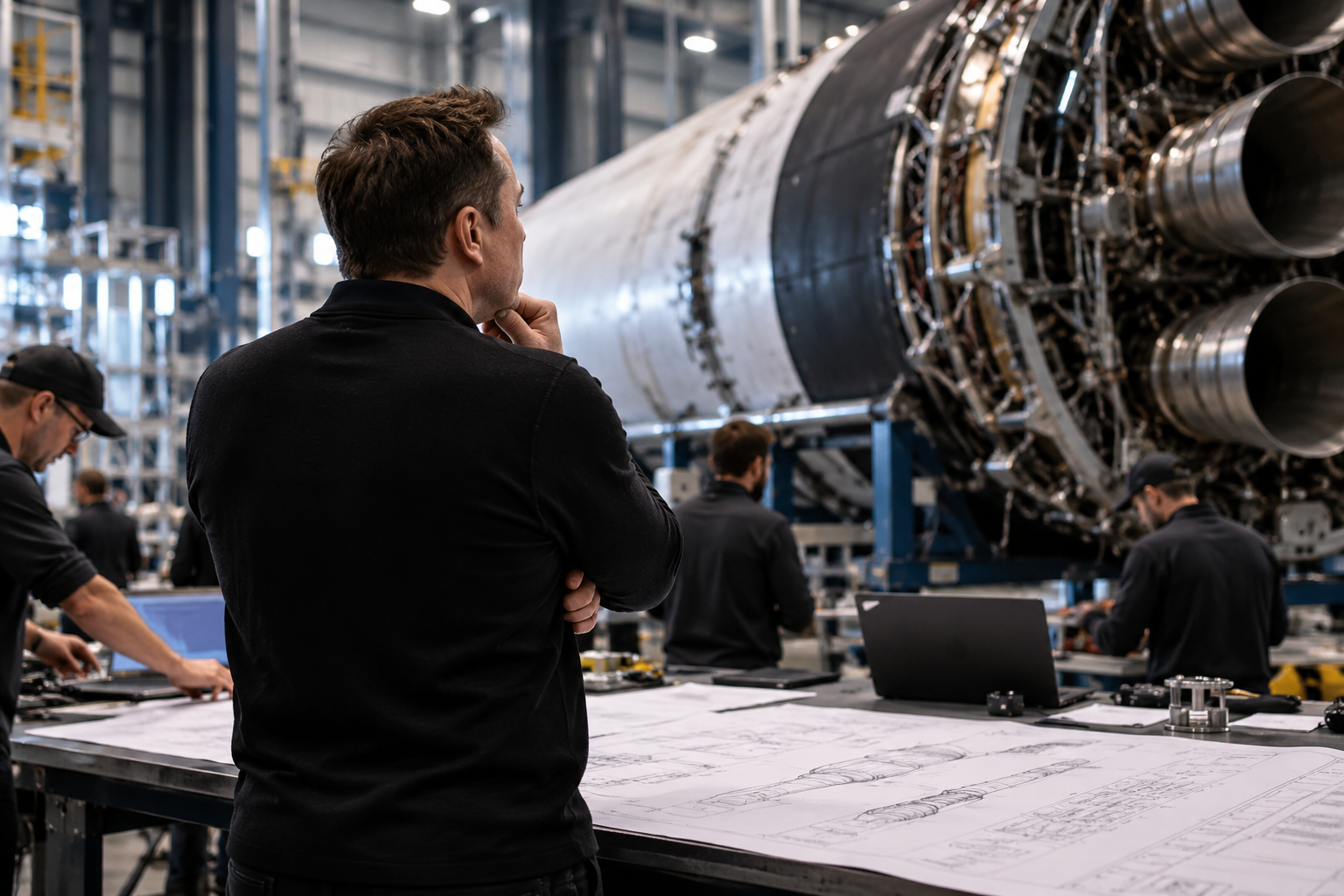
Few people in modern business have challenged as many established assumptions as Elon Musk, but the interesting thing about his career is not simply that he breaks rules. Plenty of people break rules, ignore advice or reject convention without achieving anything particularly useful. What makes Musk worth examining through a NoRuleBook lens is his tendency to look at something an industry regards as fixed and ask a more fundamental question: Does it actually have to be this way?
That question has followed him through industries that were hardly obvious targets for disruption. When he entered the automotive industry, electric cars had existed for more than a century but had never seriously displaced the internal combustion engine. When he founded SpaceX, launching rockets remained enormously expensive and much of the hardware used to reach orbit was discarded after a single flight. In both cases, there were genuine reasons why the industries had developed as they had, but Musk’s approach was not to assume that those reasons made the existing model permanent.
That distinction matters because NoRuleBook thinking is easily misunderstood as simply refusing to accept rules. It isn’t. Some constraints are real and cannot be wished away, while others exist because of laws, economics or technologies that have to be understood before they can be changed. But there is another category that is much easier to overlook: The assumptions that gradually acquire the authority of rules simply because everybody has become accustomed to working around them.
Musk’s career provides an unusually visible example of what can happen when somebody repeatedly tries to separate one from the other.
The question isn't whether you should break the rules. It's whether you've checked that they're actually rules.
WHEN AN INDUSTRY STOPS QUESTIONING THE COST
SpaceX is probably the clearest example because Musk did not begin by discovering that rockets were unnecessary or that the laws of physics could somehow be negotiated. His starting point was the enormous cost of putting something into space and a willingness to question how much of that cost was genuinely unavoidable.
Rockets had traditionally been extraordinarily expensive machines that were largely built for a single journey. They launched, delivered their payload and much of the vehicle was then discarded. There were sound historical and engineering reasons for this, and attempts at reusable spacecraft had existed long before SpaceX, so the simplistic version of the story – that Musk suddenly realized nobody had thought about reusing rockets – is clearly wrong. What he did question was whether expendability still needed to remain part of the economics of launching into space. That distinction led SpaceX towards one of the defining challenges of the company: Developing a rocket whose first stage could return to Earth, land and eventually be flown again. The process involved years of development and repeated failures, but by solving the engineering problems involved in recovery and reuse, SpaceX demonstrated that something the industry had largely learned to price into every launch did not necessarily have to remain permanent. Falcon 9 became the world’s first orbital-class reusable rocket, and reusing its first stages became a routine part of SpaceX operations.
The useful lesson isn’t the rocket itself. Most of us are never going to design a launch vehicle, and to ‘think like Elon Musk’ is not particularly useful advice. The useful lesson is what happened before the solution.
An enormous cost had become part of the way an industry operated, and instead of beginning with that cost as an unavoidable fact, SpaceX kept asking which parts of it were dictated by reality and which parts might be consequences of the way rockets had traditionally been designed and used.
That is a question with applications far beyond aerospace, because established systems naturally accumulate assumptions. Businesses inherit processes from earlier businesses, professions preserve methods that once solved genuine problems, and individuals build careers and lives around ideas they absorbed long before they ever thought to question them. Over time, the distinction between this is difficult to change and this cannot be changed can become surprisingly difficult to see.
SpaceX didn’t prove that constraints don’t matter. It demonstrated why identifying the real constraint matters so much.
TESLA QUESTIONED A DIFFERENT KIND OF RULE
Tesla faced a very different problem. There was nothing inherent in manufacturing a car that required it to be sold through an independent dealership, yet in the United States the dealership model had become deeply embedded in the automotive industry and was protected in many states by franchise laws.
Rather than accepting that distribution system had to be part of what it meant to become a car manufacturer, Tesla chose to sell directly to customers through its own stores and online ordering. That decision created years of conflict with dealer associations and regulators, including legal challenges over whether Tesla could sell directly in states where existing laws restricted manufacturers from doing so.

Tesla could question the dealership system, but it could not pretend legislation didn’t exist. Where the restriction was embedded in law, the company had to work around it, comply with it or challenge it through legal and political processes. The fact that Musk believed the traditional model was unnecessary did not make the constraint disappear.
That is a far more useful understanding of rule-breaking.
Before deciding whether a rule deserves to be challenged, you need to understand what is holding it in place. Sometimes the answer is physics. Sometimes it is law. Sometimes it is economics. But sometimes, after stripping those things away, the answer is little more than:
This is how we’ve always done it.
And that is where questioning becomes interesting.
THE VALUE — AND DANGER — OF STARTING AGAIN
Musk has often described his approach as first-principles thinking, but beneath the terminology is a fairly simple habit: Instead of starting with the existing solution and asking how it can be improved, start with the problem itself and ask what actually has to be true.
That approach can be extraordinarily powerful when an established industry has spent years optimizing the same basic model. If everyone begins from the assumption that rockets are disposable, innovation may focus on building better disposable rockets. If everyone assumes cars must pass through franchised dealerships, competitors may concentrate on improving the dealership experience rather than asking whether the dealership needs to sit between manufacturer and customer at all.
But there is an obvious danger in this way of thinking, and it is important to the NoRuleBook philosophy.
Conventional wisdom is not automatically wrong simply because it is conventional.
Industries accumulate knowledge as well as bureaucracy. Rules and practices that appear inefficient from the outside may exist because thousands of people have encountered problems that are not immediately obvious to somebody arriving with a fresh perspective. Starting again can expose assumptions that deserve to be discarded, but it can also mean rediscovering—expensively—why some of those assumptions existed in the first place.
That is why the useful lesson from Musk is not to distrust expertise, reject established practice or assume that being unconventional makes an idea better. It is to resist confusing precedent with proof.
If something has been done the same way for fifty years, that tells you there may be very good reasons for doing it that way. It does not tell you that those reasons still apply.
WHEN INDEPENDENT THINKING BECOMES OVERCONFIDENCE
The same willingness to question accepted assumptions that can reveal an overlooked opportunity can also create a different problem. Once you have been proved right about something that experienced people said would not work, it becomes tempting to assume that the next group of sceptics must be wrong as well.
That is where independent thinking can quietly become overconfidence.
Musk’s career contains plenty of reminders that challenging conventional wisdom does not guarantee that the alternative will work. He has repeatedly announced ambitious timelines that proved unrealistic, particularly around autonomous driving. Tesla vehicles have had increasingly sophisticated driver-assistance technology for years, but the fully autonomous capability Musk predicted on numerous occasions has taken considerably longer than his earlier forecasts suggested. The underlying ambition may still prove achievable, but the missed timelines illustrate an important distinction: Questioning whether a constraint can eventually be overcome is very different from accurately knowing when or how it will be overcome.
The same principle applies more broadly. An industry can be wrong about what is possible without the person challenging it automatically being right about the solution. A convention can deserve questioning without deserving rejection, while expertise can sometimes look like resistance simply because experienced people understand difficulties that are not immediately obvious from the outside. This is why useful contrarian thinking requires something more than confidence. It requires evidence strong enough to change your mind.
If the purpose of questioning a rule is merely to prove that everyone else is wrong, then rule-breaking has become its own form of conformity. You are no longer thinking independently; you are simply committed to the opposite position.
The real discipline is being willing to challenge an assumption aggressively while remaining equally willing to discover that the assumption existed for a good reason.
Independent thinking doesn't mean assuming the crowd is wrong. It means deciding for yourself whether the crowd is right.
THE REAL LESSON IS NOT TO THINK LIKE ELON MUSK
There is a tendency when studying successful people to turn their behaviour into instructions. Find something unusual they did, connect it to an extraordinary outcome and conclude that the rest of us should do the same.
That would be particularly dangerous with Musk because many of the decisions available to him exist within circumstances most people will never share. The financial resources, engineering talent, access to capital and tolerance for failure available to a billionaire running large technology companies bear little resemblance to the choices facing someone deciding whether to change careers, start a small business or challenge an established practice at work.
The useful part of Musk’s approach is therefore not his appetite for risk, his personality or even his willingness to ignore people who disagree with him. It is the question underneath many of his decisions:
That question changes the way a problem is examined. Instead of accepting “We can’t do that” as the end of the discussion, it asks what specifically makes it impossible. If the answer is cost, what creates the cost? If it is regulation, what does the regulation actually require? If it is technology, which capability is missing? If it is simply “Nobody in this industry does that,” then you may have discovered something very different from a genuine constraint.
This does not mean every assumption deserves hours of investigation. Most established practices work perfectly well, and constantly rebuilding everything from first principles would make ordinary life almost impossible. The value lies in recognizing the moments when an assumption is important enough to your outcome that accepting it without examination carries a real cost.
That may be an assumption that you need a particular qualification before entering an industry, that a product has to be sold in a particular way, that a business must reach a certain size to compete, or that a career has to follow the sequence everyone around you considers normal. Sometimes examination will confirm that the constraint is real. Sometimes it will reveal that there are good reasons for the conventional approach. But occasionally, the answer will be surprisingly weak. And those are the rules worth looking at more closely.
WHICH RULES ARE ACTUALLY RULES?
The most useful lesson from Musk’s career is not that rules should be broken, but that accepted constraints deserve to be understood before they are accepted.
SpaceX questioned whether expendability had to remain embedded in the economics of orbital launch. Tesla questioned whether becoming a major car manufacturer required adopting the industry’s established distribution model. Neither challenge succeeded because somebody simply decided that the old rules no longer applied. They required engineering, capital, persistence, experimentation and, where genuine legal restrictions existed, years of navigating or challenging them. That difference matters.
Breaking a rule because you dislike it is easy. Understanding why the rule exists, identifying what is genuinely fixed and then finding a better way through what remains is much harder.
NoRuleBook has never been about living as though rules do not exist. The more useful idea is to become conscious of which rules are shaping your decisions and to understand whether they represent genuine constraints, useful accumulated wisdom or assumptions that have simply acquired authority through repetition.
So when you encounter a rule that stands between you and something you want to do, don’t begin by asking how to break it. Ask a better question:
Take The Next Step
Many of the rules influencing our lives are much less obvious than the ones Elon Musk has challenged. They appear in the assumptions we inherit about careers, business, education, money, success and what a sensible life is supposed to look like, and because those assumptions are shared by the people around us, they can be surprisingly difficult to recognise.
The NoRuleBook eBook is about making those unwritten rules visible and examining them before allowing them to determine your choices. It isn’t about rejecting conventional wisdom or breaking rules for the sake of being different. It is about understanding which constraints are real, which rules still serve a useful purpose and which assumptions deserve to be questioned.
If you want to start identifying the unwritten rules shaping your own decisions, click the NoRuleBook image below to get your copy.
The NoRuleBook Collection
-
NoRuleBook
$9.95Original price was: $9.95.$7.95Current price is: $7.95. -
No Rules Start-Up
$19.95Original price was: $19.95.$9.95Current price is: $9.95. -
NoRuleBook Bundle
$22.90Original price was: $22.90.$14.95Current price is: $14.95.