

The Story Almost Everyone Gets Wrong
Mention the Red Bull lawsuit at a barbecue, around the office, or over dinner with friends and there’s a good chance someone will smile before saying, “Oh yeah … Wasn’t that the guy who sued because he didn’t grow wings?” It’s one of those stories that has become part of popular culture because the punchline is simply too good not to repeat. A man drank an energy drink, didn’t suddenly grow feathers, so he decided to sue the company. At least, that’s the version most people remember.
Like many stories that survive long enough to become modern folklore, the Red Bull lawsuit has gradually been polished into something shorter, funnier and easier to retell. The facts haven’t disappeared altogether, but they’ve been pushed aside by a version that makes for a better anecdote. After all, reality rarely competes well with a good story.
That is precisely what makes this case so interesting.
Because the more closely you look at what actually happened, the more you realize it was never really about wings at all.
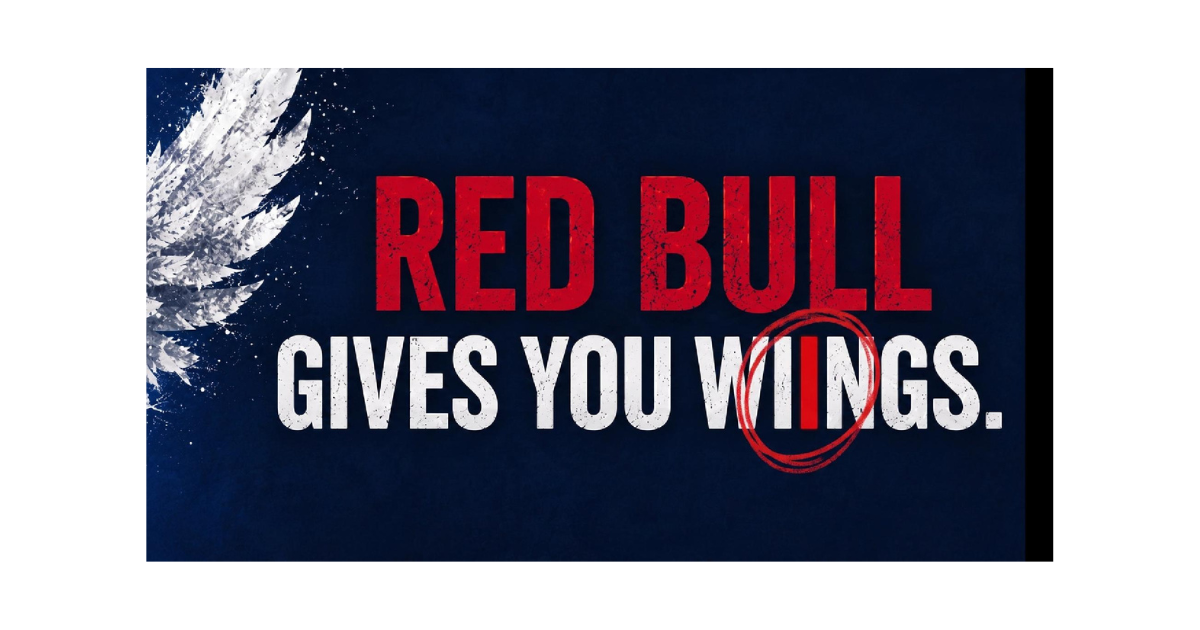
Walk into almost any supermarket and you’ll find shelves lined with brightly colored cans, each one promising something a little different. Some promise hydration. Others promise endurance, focus or recovery. Few, however, have embedded themselves into popular culture as successfully as Red Bull. ‘Red Bull Gives You Wings’ became one of those rare advertising slogans that escaped the confines of television commercials and took on a life of its own.
It’s difficult to know exactly how many times the average person has seen or heard those five words. Thousands of times, perhaps? It constantly appears in television commercials. OIs emblazoned on Formula One cars. Appears at most global extreme sports events. On roadside billboards. Across social media. At music festivals. The list goes on.
Eventually, after such saturation of advertising, something curious happens. The slogan will stop feeling like advertising. It becomes part of the background, woven so deeply into everyday life that most of us no longer notice it. Like the logo on a familiar cereal box, or the sound of a train passing in the distance, it simply becomes another ordinary part of the world.
Advertising has an unusual relationship with repetition. The first time we hear a message, we evaluate it. By the hundredth time, we barely notice it. By the thousandth, it no longer feels like a message at all. It simply becomes part of our mental furniture, quietly sitting alongside countless other ideas we’ve absorbed without ever consciously deciding whether they deserve to be there.
Most people never give Red Bull’s famous slogan another thought. But Benjamin Careathers did.
Not because he expected to grow wings, nor because he had set out to challenge one of the world’s most recognizable brands. He simply found himself asking a remarkably ordinary question : If Red Bull’s advertising suggested improved mental and physical performance, was it actually offering anything that couldn’t already be found in an ordinary cup of coffee?
It was such a simple question that almost nobody thought to ask it.
The Question Nobody Else Was Asking
Benjamin Careathers wasn’t trying to become famous, and he wasn’t campaigning against energy drinks. Nor was he attempting to bring down one of the world’s most successful brands. By all accounts, he was simply another Red Bull customer who had been buying the product for years.
Like millions of other consumers, he’d seen the advertisements countless times. He knew the slogan. He understood that Red Bull wasn’t claiming people would literally grow wings and fly through the air. Nobody seriously believed that.
But Benjamin began wondering about something else.
Red Bull’s marketing didn’t just promise wings. For years it had associated the drink with sharper concentration, improved physical performance and the kind of energy needed to push beyond ordinary limits. It sponsored Formula One teams, extreme sports athletes, cliff divers, mountain bikers and air races, creating an unmistakable connection between the product and exceptional performance. Whether viewers realized it or not, the message was remarkably consistent: This wasn’t simply another drink. It was something different. Something better.
Benjamin’s question was surprisingly straightforward.
If Red Bull was being sold as a premium performance drink, was there any reliable evidence that it aided performance significantly better than someone drinking a much cheaper cup of coffee, containing a similar amount of caffeine?
It’s an interesting question because it isn’t really about Red Bull.
It’s the sort of question we rarely ask about anything.
Most of us don’t spend our lives carefully analyzing every advertising claim we encounter. There simply isn’t enough time. Instead, we make thousands of small assumptions every day. We assume the more expensive product must be better. We assume the market leader has earned its reputation. We assume that if millions of people buy something, someone else must already have checked the details.
Most of the time those assumptions probably don’t matter.
Occasionally, they become so deeply embedded that we stop recognizing them as assumptions at all.
Benjamin decided to look more closely.
From a Simple Question to a Lawsuit
When Benjamin Careathers filed his lawsuit against Red Bull in 2013, he wasn’t asking a court to decide whether people could literally grow wings after drinking an energy drink. Such folklore has been repeated so often that it has almost eclipsed the real case.
Instead, the lawsuit argued that Red Bull’s long-running advertising had created the impression that the drink provided superior mental and physical performance. This despite there being little evidence that it offered benefits beyond those of caffeine alone. If consumers were paying a premium because they believed those messages, was the advertising crossing a line?
Whether you agree with that argument or not, it’s a far more thoughtful question than the popular version of the story suggests.
Most people expected Red Bull to defend the case all the way through the courts. Instead, something unexpected happened.
In 2014, Red Bull agreed to settle the lawsuit for US$13 million while continuing to deny any wrongdoing. Eligible customers in the United States were offered either a cash payment or free Red Bull products, as part of the settlement.
For many people, that was the end of the story.
For NoRuleBook, it’s where the story becomes interesting.
Prefer To Watch
If you’d rather experience this story as a short documentary, you can watch the NoRuleBook video below before continuing with the deeper ideas behind what this case really reveals.
The Invisible Power Of Familiarity
One of the most interesting aspects of the Red Bull lawsuit isn’t that Benjamin Careathers questioned an advertising slogan. It’s that millions of us never did.
It’s not because people are gullible, or because we’re incapable of thinking for ourselves. It’s actually more so because our brains have evolved to become remarkably efficient at filtering an overwhelming amount of information every day so we can focus on what seems most important. If we stopped to scrutinize every advertisement, every headline, every recommendation and every opinion we encountered, we’d never make it through the day. Instead, we rely on mental shortcuts. Nowadays, we have become familiar with certain brands, certain ideas and certain ways of looking at the world, and gradually accepted them as part of the landscape rather than something requiring constant evaluation.
Most of the time, that serves us well. Familiarity allows us to navigate life without having to reinvent every decision from first principles. We don’t research every supermarket product before putting it into the trolley, nor do we investigate every company before buying from them. Trust, habit and familiarity make modern life possible.
The difficulty is that familiarity doesn’t simply just help us recognize something quickly. Given enough time, it also changes the way we think about it. An idea repeated often enough gradually stops feeling like a claim that could be questioned and starts feeling like an ordinary fact about the world. We rarely notice the transition because it can happen so gradually. Almost invisibly, until one day the idea no longer feels like someone else’s opinion at all. It simply feels true.
Advertising has understood this for decades. The campaigns we remember aren’t necessarily the cleverest or the most persuasive. More often, they’re the ones that patiently repeat the same message until it becomes inseparable from the product itself. Eventually, the slogan fades into the background. We stop hearing it as advertising and begin accepting it as part of the product’s identity.
Yet this phenomenon extends far beyond advertising. The same process quietly shapes the careers we admire, the houses we aspire to own, the universities we dream of attending, the milestones we aspire for our lives to reach, and even the way we define success. Many of these ideas are worthwhile. Some are not. The point isn’t that they’re right or wrong. It’s that very few of us ever stop to ask where they came from, or whether we’ve consciously chosen to believe them.
That’s what makes Benjamin Careathers such an unexpectedly interesting character in this story. He didn’t uncover a corporate conspiracy or expose some elaborate deception. He simply interrupted a thought process that millions of other people had accepted without ever noticing they had accepted it. In doing so, he reminds us that the most powerful unwritten rules are often the ones we don’t even recognise as rules anymore. They’ve become so familiar that they simply feel like the way the world is.
The Rules We Never Realize We're Following
If you asked most people whether they live by a set of rules, they’d probably say no. Rules are things imposed by governments, schools or employers. They’re written down, enforced and easy to identify.
The rules that shape our lives most profoundly, however, are often nothing like that.
They’re inherited quietly, absorbed over years through family conversations, advertising, popular culture, classrooms, workplaces and the simple act of watching how everyone else behaves. Nobody sits us down and says, “This is how life must be lived.” Instead, the message arrives in fragments, repeated so often and from so many different directions that it eventually feels less like advice and more like reality.
Work hard. Buy a house. Climb the ladder. Earn more. Stay busy. Don’t change careers too late. Success looks like this. Happiness comes after that.
None of these ideas are necessarily wrong. Many contain genuine wisdom. The problem begins when we stop recognising them as choices.
Somewhere along the way, possibilities quietly become expectations. Expectations become assumptions. Assumptions become invisible rules.
That’s why stories like the Red Bull lawsuit matter. Benjamin Careathers wasn’t simply questioning an advertising campaign. Whether he intended to or not, he was demonstrating something much broader : That it’s possible to pause, look at an idea everyone else seems comfortable accepting and ask a deceptively simple question.
“Is this actually true?”
Sometimes the answer is yes.
Sometimes it’s no.
But the value lies in asking the question before accepting the conclusion.
That habit of curiosity sits at the heart of almost every meaningful change in history. Scientific discoveries, social progress, new businesses and personal reinventions have all begun in much the same way -Not with certainty, but with someone becoming curious enough to question what everyone else had stopped noticing.
Perhaps that’s why the Red Bull story continues to resonate. On the surface, it’s an amusing lawsuit with an unforgettable headline. Beneath that headline, however, lies something far more enduring. It’s a reminder that the ideas shaping our lives don’t become powerful because they’re shouted the loudest. They become powerful because they’re repeated often enough that we eventually stop seeing them as ideas at all.
And once that happens, they no longer feel like rules. They simply feel like reality.
One Question Worth Asking
The Red Bull lawsuit didn’t change the world. Energy drinks are still sold in supermarkets. Advertising slogans still compete for our attention.
Most people have long since forgotten the details of the case, remembering only the amusing headline about a man who supposedly sued because he didn’t grow wings.
Perhaps that’s inevitable. Simple stories are easier to remember than complicated truths.
Yet Benjamin Careathers left behind something more valuable than most people realize. He demonstrated that curiosity doesn’t always begin with a grand act of rebellion. Sometimes it begins with nothing more dramatic than refusing to let familiarity do all your thinking.
That habit is becoming increasingly rare.
We live in a world where information travels faster than ever before, opinions spread across social media in seconds, and algorithms become remarkably good at showing us more of what we’ve already accepted. In that environment, the greatest challenge isn’t finding answers. It’s remembering to pause long enough to ask whether we’ve ever questioned the assumptions those answers are built upon.
That’s where NoRuleBook begins.
Not by telling people what to believe, nor by encouraging them to reject every convention they encounter. Some rules deserve to be followed. Some traditions exist for very good reasons. The goal isn’t to replace one set of unquestioned beliefs with another.
The goal is simply to notice invisible rules before deciding whether they deserve a place in your life.
Benjamin Careathers questioned an advertising slogan that millions of people had stopped noticing. The next invisible rule you encounter probably won’t be printed on the side of an energy drink can. It might concern success, work, money, relationships, ageing or happiness. It may even be an assumption you’ve carried for so long that you’ve forgotten it was ever a choice.
But the question is still the same.
“Is this actually true?”
Perhaps the most important rule you’ll ever question is the one you never realized you were following.

 Submitted 1.0
 Manual 5.0